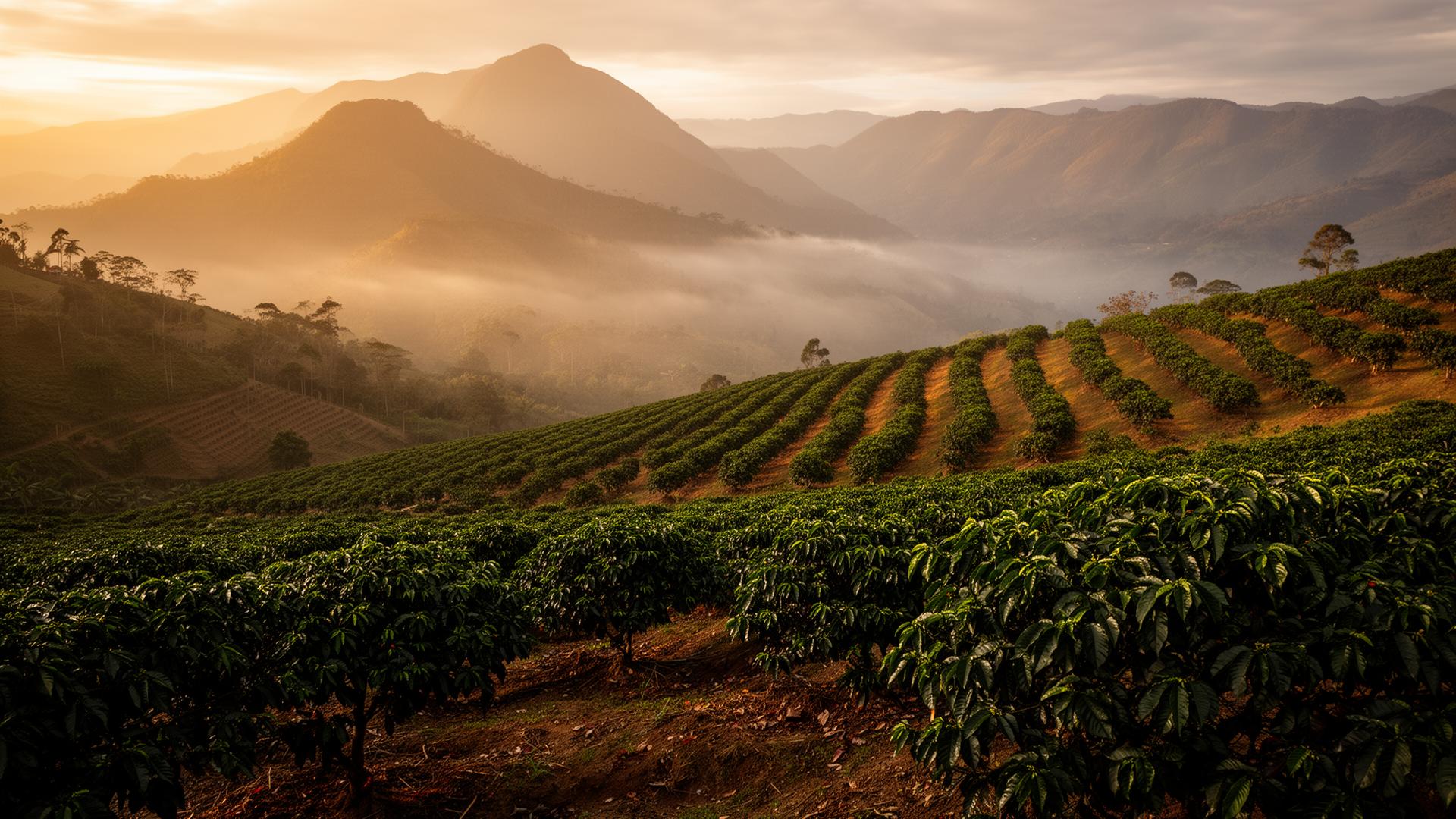
Before a coffee reaches an oak barrel or enters botanical maturation, it first has to come from somewhere. At Quercus, that somewhere isn't a single farm — it's a region. Quercus doesn't depend on a single farm: it builds a first layer of consistency through regional sourcing across Caldas, Huila, and Tolima, selecting raw material under defined specifications before applying any maturation architecture.
Why region, not farm
Each lot of Quercus's raw material can group coffee from several nearby farms within the same region, selected under defined quality and origin specifications. The varieties used are Castillo and Caturra. That regional sourcing is the first layer of consistency, even before the coffee enters the maturation process: not depending on a single farm is part of the repeatability architecture that sustains Quercus's profiles.
The traceability Quercus offers sits at the region and municipality level — the level this sourcing model can honestly support.
The three regions
Quercus currently sources from Caldas, Huila, and Tolima.
Caldas is Quercus's home base and a historic coffee region within Colombia's Coffee Region. The company operates here, in Chinchiná, and Caldas is one of the regions able to supply raw material within this regional sourcing model.
Huila is a widely recognized coffee region in Colombia, with diverse municipalities and growing conditions. It's one of the sources in Quercus's sourcing, selected under specifications defined by Quercus that support building consistent lots.
Tolima is a diverse coffee region and another source within Quercus's current sourcing model. Its coffee is selected under specifications defined by Quercus, within the sourcing model that supports the company's consistency architecture.
What this means for a buyer
Caldas, Huila, and Tolima are part of Quercus's current regional sourcing model. Their role is integrated with sourcing specifications, process protocols, and lot-level validation.
For a roaster, importer, or distributor, this means Quercus's consistency doesn't start at the barrel or in botanical maturation. It starts earlier, in the regional selection of raw material — one more layer of an architecture built to hold up across orders.
What comes next
With this, the arc is complete: what barrel-aged is, how it compares to other processes, how Noble Cask sustains a documented sensory identity, why a professional buyer needs repeatable differentiation, and where the green coffee behind all of it begins.
Want to discover the profiles built from this sourcing and process architecture?